

What We Handle
Practice Areas
Tap any area to learn more

Our car accident lawyers help victims who've been hurt in a crash seek compensation for injuries from the at-fault party. This can include medical bills, lost wages, pain and suffering, and property damage.
Learn More
Injured in an accident involving a truck or commercial vehicle? An experienced truck accident lawyer can help you seek compensation for your injuries.
Learn More
Motorcycle accident lawyers help victims seek justice and navigate aftermath. Motorcycle accidents are more likely to cause serious injuries due to lack of protection for riders.
Learn More
Uber and Lyft accidents involve layered insurance policies that companies try to use against you. Whether you were a passenger, driver, or another motorist, we untangle the coverage disputes and fight to make sure you are fully compensated — not left holding the bill.
Learn More
Pedestrians struck by vehicles often suffer the most severe injuries. With no vehicle to absorb impact, the consequences can be devastating. We aggressively pursue full compensation for your medical treatment, rehabilitation, lost wages, and the long-term impact on your life.
Learn More
Cyclists deserve to share the road safely. When a driver's negligence causes a crash, we stand up for your rights. We handle the insurance companies and legal process from start to finish, so you can focus on your recovery while we fight for the compensation you deserve.
Learn More
Losing a loved one due to someone else's negligence is devastating. While nothing can replace what you've lost, holding the responsible party accountable matters. We handle wrongful death cases with the compassion your family deserves and the tenacity the situation demands — fighting for full compensation for your loss.
Learn MoreWE OFFER YOU WHAT OTHER
LAW FIRMS WON'T
Weekly Update Calls
If you read online reviews, you will see the number one complaint of law firms is they never call their clients. That is why we are dedicated to making sure you receive a call at least once a week to update you on your case and to check on you, not only as a client, but as an actual person.

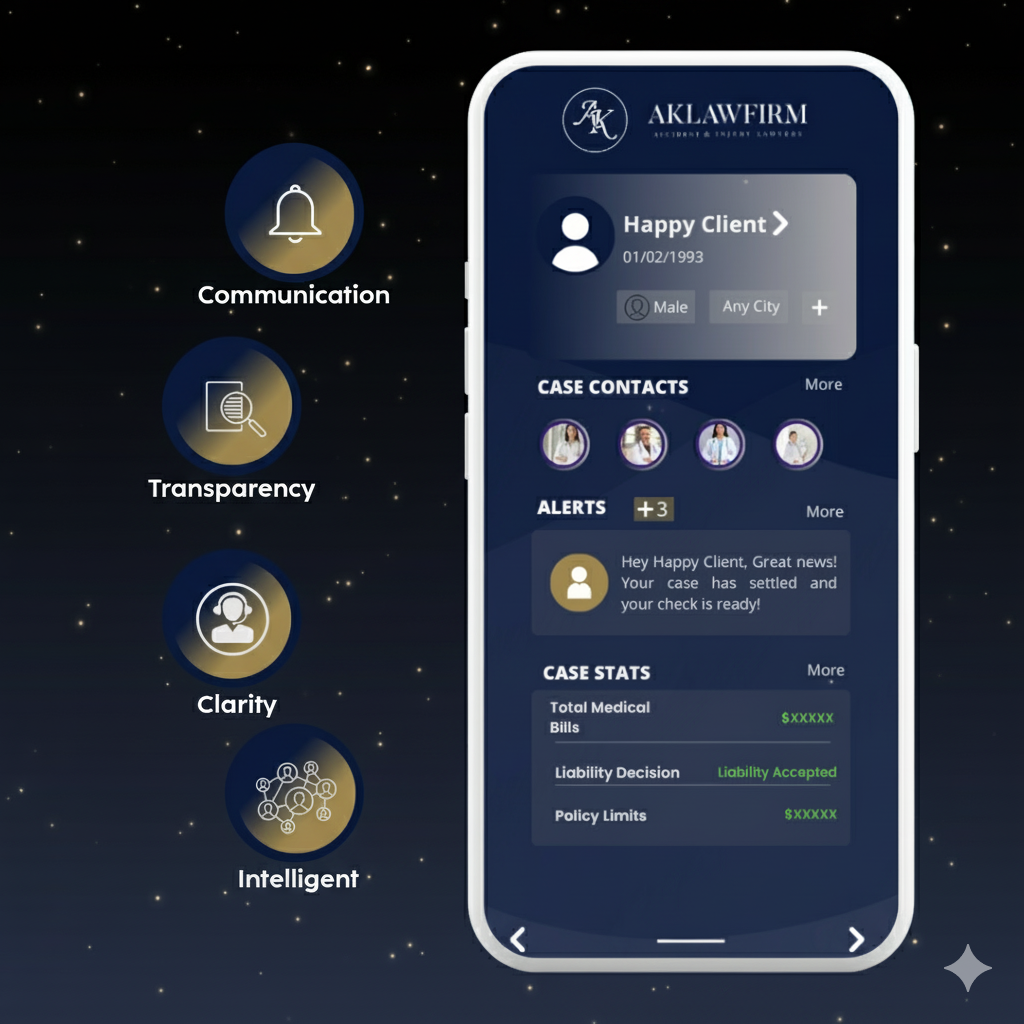
24/7 Online Access to Your File from your Phone
We don’t keep you in the dark. It is your file, so why shouldn’t you have access to it? We believe in transparency at a level you won’t find anywhere else.

WHY AK LAW FIRM IS DIFFERENT
I started the AK Law Firm with the idea that if we put the clients’ needs first, the results will follow – and I have been right.
At the AK Law Firm we have a commitment to put everything we have into every single case, and to ALWAYS put the client first.

Spanish Speaking Lawyers Serving All of Texas
Millions of residents across Texas speak Spanish as their primary language. Yet many car accident victims never pursue the compensation they deserve because of language barriers or the fear of being misunderstood throughout the legal process.
AK Law Firm’s Spanish-speaking lawyers believe every injured person deserves clear guidance in the language they’re most comfortable with. Our attorneys and support staff work directly with Spanish-speaking clients at every stage of a case. From the first call through settlement negotiations, we make sure your story—and your legal rights—are always understood.

What Bilingual Legal Representation Really Means
Many law firms advertise bilingual lawyers but rely on interpreters or outside translators. At AK Law Firm, bilingual representation means something very different:
Direct attorney communication in Spanish
Our Spanish-speaking attorneys communicate with you directly, so important legal information never gets lost through translation.
Attorneys who understand Texas law and the communities they serve
Our bilingual attorneys help clients navigate the legal system while respecting the cultural context and concerns associated with serious accidents.
Full representation in your preferred language
From the accident investigation to settlement, every part of your case can be handled in Spanish.
Immigration status is not a barrier to justice
Anyone injured in Texas has the right to seek compensation after an accident, regardless of immigration status. Our team works to protect your rights and ensure you are treated fairly under Texas law.
Helping Spanish-Speaking Accident Victims Across Texas
With offices in Houston, Dallas, and San Antonio, AK Law Firm’s statewide reach ensures that every family has access to experienced Spanish-speaking lawyers in Texas. If you or someone you love was injured in an accident, you deserve legal guidance from a team that understands both the law and the personal challenges that accident victims face.
Call today to be connected with one of AK Law Firm’s Spanish-speaking lawyers. We offer free consultations, and there are no fees unless we win compensation for you.
Many personal injury lawyers opt for quick, small settlements instead of fighting for the full payout their clients deserve.
WE STAND OUT. WE FIGHT TO THE FINISH.
WATCH & LEARN HOW AK OFFERS YOU MORE





Top-Rated Personal Injury Lawyers in TX
Trusted by over 4,000+ clients in the last 5 years
Car Accident FAQ
Frequently Asked Questions
traight answers to the questions we hear most after a Texas car accident. Tap any question to read the full answer.
Right After the Crash
What should I do at the scene of a car accident?
Your priority is safety, not your claim. If you can move without risking injury, get yourself and any passengers out of traffic. Where it is safe to do so, leave the vehicles where they came to rest until you have photographed them, because the resting position relative to lane lines, a stop sign, or an intersection often tells the story of who failed to yield. If staying put is dangerous, move to safety first and photograph afterward.
Once you are safe, build a record before anything at the scene changes:
- Photograph everything, generously. Capture damage to every vehicle from multiple angles, including close-ups and wide shots. Some drivers will downplay or even quietly start “fixing” their damage, so document it before they can. Photograph the roadway, signage, signals, skid marks, debris, weather and lighting conditions.
- Call the police and get a report. Even when the other driver admits fault at the scene, memories and stories shift once everyone goes home. If they are willing to take responsibility, have them say so to the responding officer. If they deny fault, an officer taking statements from the drivers and any witnesses becomes even more important.
- Lock down witnesses. Witnesses leave, and many later decide they would rather not get involved. At minimum, collect each witness’s name and phone number; if they agree, record a short video of what they saw.
- Note nearby cameras. Look for businesses, doorbells, traffic poles, or homes that may have captured the crash. Many private systems overwrite footage within a few days to a couple of weeks, so the window to preserve it is short.
Evidence disappears quickly. By hiring a law firm we are able to review the evidence you have and what is missing. If anything is missing, we can help in gathering what is still remaining. This evidence can be the difference in winning or losing your case. We also send out spoliation letters to the potentially at-fault drivers and companies to make sure they don’t get rid of evidence that could win your case. Do what you can to secure evidence, then call the AK Law Firm to make sure you have everything you need to win your case.
My car is not drivable or is totaled, but I can move around — what do I do?
Tell the 911 dispatcher that your vehicle is disabled when you call. After you are clear of the car (or freed from it, if doors are jammed), responding officers or firefighters can sometimes move it out of the travel lane, and you or the authorities can arrange a tow.
If you prefer a specific tow company or mechanic, raise that with the dispatcher or the officer on scene. You may be able to direct the tow yourself, or police may need to hold the vehicle as evidence. If it is held, your attorney can act as the go-between with law enforcement, so your personal belongings are recovered and your privacy is protected.
Do I have to report even a minor accident to the police?
In Texas, sometimes you are legally required to. Under the state’s crash-reporting law, you must promptly notify police when a crash causes injury or death or causes apparent property damage of $1,000 or more — a figure that is easy to exceed today, since even a modest bumper repair can run past it. Failing to report a qualifying crash can carry serious penalties.
Beyond what the law strictly requires, calling police protects you whenever the situation is murky. It is worth making the call when: the other driver disputes how the crash happened, the other driver is uninsured, weather or road conditions played a role, or the other driver is hostile. People often talk themselves out of calling, assuming it is too minor to bother with — but an official report with driver and witness accounts can be the difference between a paid claim and a “he said, she said” you lose.
When in doubt, call. It is far better to learn the report was unnecessary than to wish you had one.
Note: Texas no longer accepts the old driver-filed “blue form” (CR-2) with the state. The official record is the Peace Officer’s Crash Report (CR-3) the responding officer prepares.
Should I talk to the police after a crash, and what should I say?
Yes — but choose your words carefully. You cannot simply refuse to engage; you are required to show the officer your driver’s license, registration, and proof of insurance, and refusing can lead to arrest.
How much else to say depends on your situation. If the other driver is plainly at fault and you broke no traffic laws, there is little harm in giving your account — just stick to what you directly observed and do not speculate. If you are unsure how the crash happened, there is a real risk of saying something that points blame at yourself before you know the full picture, so it is reasonable to politely hold off on a detailed statement until you have spoken with an attorney.
A few things to avoid no matter what:
- Never say “I’m sorry.” A reflexive apology can be treated as an admission of fault. Stay polite without apologizing.
- Don’t interrupt or “correct” the other driver while they speak to the officer. You will get your turn, and you can clarify the record later.
Should I talk to the other driver?
Keep it brief and factual. Exchange names, addresses, phone numbers, and insurance details, and provide the same in return. Do not discuss how the crash happened or who was at fault. Anything you say — even something as ordinary as “I’m sorry” — can be repeated to an insurer and used to shift blame onto you.
What evidence should I gather to support my case?
The stronger your documentation, the harder it is for an insurer to dispute. If your injuries allow you to do so, collect the following at the scene:
- Photos and video of every vehicle from all angles, with close-ups of each dent and scratch.
- A wide shot of the whole scene for context.
- Anything else that could matter: road signs, signals, skid marks, debris, weather, and traffic conditions. You can never have too many pictures and too much information.
- Photos of any visible injuries.
- Witness and passenger names and contact information (keep questions short at the scene).
- A written account of how the crash happened, in your own words, as soon as you can. Crash memories blur quickly, and a contemporaneous note is valuable later.
Keep building the record in the days and weeks that follow:
- Continue photographing injuries as they heal to show their progression.
- Save every medical appointment and bill, including prescriptions and mileage to and from treatment.
- Track all crash-related costs — property damage, medical expenses, lost income.
- Keep a short journal of how the crash has affected your daily life, pain levels, and mental state.
Once you call the AK Law Firm we open your file immediately and begin to store and organize all the evidence to support your case. We have proprietary software that organizes and reviews your evidence so that we can easily see if anything is missing and what we need next. The first weeks of your case are the most important in gathering evidence and you should never try to do it alone.
What are the most common mistakes people make after a crash?
What you avoid doing matters as much as what you do. The errors that most often damage a claim:
- Not calling the police.
- Not exchanging insurance information.
- Failing to notify your own insurer.
- Admitting or speculating about fault.
- Delaying medical care.
- Giving the other driver’s insurer a recorded statement.
- Posting about the crash on social media (insurers do look).
- Accepting the first lowball offer.
- Trying to handle a serious claim without an experienced lawyer.
Medical Care & Injuries
Do I need to see a doctor after a car accident?
In most crashes, you will not feel your worst until three to five days later. This is not medical advice, but in our experience — with clients and from being in collisions ourselves — a wreck can tear or strain muscles, compress nerves in your back, and cause spinal discs to bulge.
Immediately afterward, your body reflexively tenses as a protective response, and that tightening tends to intensify over the following days. Severe initial pain can also mask other, more serious problems; we have seen clients whose arm or leg numbness was not recognized as significant for months. Some symptoms come from inflammation that resolves on its own, while others signal something lasting. Letting your body move past the initial shock is how you find out which it is.
If your crash was anything but trivial, see a doctor even if you do not feel badly hurt — and go the same day if you hit your head, have a bad headache, neck stiffness, or any numbness, tingling, or shooting pain down your arms or legs. Some people go to the ER when they did not strictly need to, but “better safe than sorry” genuinely applies. If you walked away feeling fine, use common sense.
There is a practical claims reason to be seen promptly, too: if you wait too long to get checked out, insurers will argue your injuries came from something other than the crash. Documenting your condition early ties your injuries to the collision.
Can I still bring an injury claim if I have never seen a doctor?
Not a successful one. To recover medical expenses after a Texas crash, you need official medical documentation. Seeing a doctor promptly protects both your health and your claim — it is a necessary part of the process, not an optional step.
Should I go to the hospital right away?
If you feel dizzy or nauseated or have any sharp pain after impact, seek emergency care. If an ambulance comes to the scene, the crew will advise whether you should go to the nearest ER. Either way, follow up with your regular physician for any lingering pain or discomfort.
What injuries might I have that I can’t see?
Some of the most serious crash injuries do not show on the surface or do not hurt right away:
- Head, neck, and spine. Traumatic brain injuries, whiplash, and damage to discs or the muscles supporting the spine can take hours or days to produce pain.
- Ligaments and muscle. Anyone who has had a sports injury knows a torn ACL or rotator cuff often “pops” at the moment of impact. In the chaos of a crash you may not notice it — but continuing to use a torn ligament can worsen the damage and limit how fully you recover even after surgery.
- Soft tissue and internal injuries. Internal tears, ruptures, or bleeding may not be visible. A damaged organ can bleed without any outward bruising, creating real danger.
- Psychological injury. This is invisible too, but anxiety, depression, and PTSD symptoms can seriously disrupt your life.
A surge of adrenaline during the crash can blunt pain for hours, which is exactly why a prompt professional evaluation matters — both to treat injuries before they worsen and to establish a clear link between the collision and the symptoms that follow.
What kinds of injuries actually require a doctor rather than a chiropractor?
Chiropractic care can be one part of a treatment plan, but several common crash injuries need medical diagnosis and treatment a chiropractor cannot provide:
- Spinal cord injury — can cause loss of sensation or movement and requires stabilization, hospitalization, and a neurological specialist.
- Internal injuries — sometimes mistaken for ordinary back pain that sends people to a chiropractor; an adjustment does nothing for internal bleeding.
- Injuries needing surgery — soft-tissue tears, fractures, and other trauma require an orthopedic specialist or surgeon, not spinal manipulation.
What medical evaluation should I expect?
A thorough post-crash workup may include a physical exam (checking range of motion, pain, and any swelling, redness, or warmth that can signal an internal problem), eye and cognitive testing (looking for signs of head or brain injury, such as uneven pupils or slurred speech), and imaging (MRI, CT, or X-ray to find injured bone or tissue, internal bleeding, or foreign objects). A complete workup catches early signs of injury and, in some cases, can be lifesaving.
Dealing with Insurance
Do I have to talk to the other driver’s insurance company?
No, and you should not — at least not before speaking with your own lawyer. The other driver’s insurer exists to limit what it pays. Friendly tone aside, the adjuster is gathering statements they can use to deny or shrink your claim. If they call, you can simply direct them to your attorney.
You should, however, promptly notify your own insurer that a crash occurred so your claim can be opened. Even then, you are within your rights to consult a lawyer before giving a full recorded statement, because your own insurer’s financial interest is not always aligned with paying your claim in full.
Should I give a recorded statement to any insurer?
No. Insurers — including your own — ask for recorded statements to find things to use against you. Once your words are on the record, an innocent inconsistency later can be used to attack your credibility and your claim. Decline the recorded statement and talk to a lawyer first.
Which adjuster questions are safe to answer, and which are not?
Some basic, factual questions are fine to answer:
- When and where the crash happened.
- The year, make, and model of your vehicle.
- Whether other vehicles were involved.
- The general nature of the damage and whether your car needs repair.
- Whether a police report was filed.
Be very cautious — ideally, decline until you have talked to a lawyer — with questions that invite you to characterize fault or injuries:
- “How did the accident happen?” / “Which direction were you going?” Detail here can be spun into an argument that you caused the crash.
- “Were you wearing your seatbelt?” Used to argue you share responsibility for your injuries.
- “Did weather play a part?” Used to argue you drove too fast for conditions even if you were under the speed limit.
- “Were you hurt?” / “How are you feeling?” Listing only the injuries you know about now can limit later claims for injuries diagnosed afterward, and a polite “I’m fine” can be treated as proof you were not seriously hurt. It is better not to discuss injuries at all.
Should I let the adjuster access my medical records?
No — never sign a blanket medical release. Full access lets the insurer go fishing through your history for anything it can blame your injuries on instead of the crash: old injuries, prior surgeries, or degenerative conditions like arthritis or pre-existing disc problems. Conditions such as narcolepsy or medications that cause drowsiness can also be twisted into an argument that you caused the wreck. Your lawyer can provide only the records that are actually relevant.
What if the insurance company denies my claim?
A denial is not the end. Read the denial letter closely to understand the stated reason, then gather the additional evidence needed to challenge it through the insurer’s internal appeal. If the denial stands after appeal, you can file a lawsuit against the insurer or the at-fault driver.
Should I accept a settlement offer soon after the crash?
Be wary. Early offers are often calculated to settle before you know the full extent of your injuries and losses, and insurers know many people need cash quickly after a wreck. The catch is that once you accept and sign a release, you usually cannot ask for another dollar — ever — even if your condition worsens. Have the offer reviewed before you sign.
Can I ask for more money?
Yes, and you often should. Insurers rarely lead with an offer that covers everything. There is a myth that hiring a lawyer leaves you worse off after fees — if that were true, the profession would not exist. In practice, experienced representation is how you make sure every category of loss, including your bodily injury, is actually accounted for.
Why are quick settlements usually a bad deal?
Legitimate claims take negotiation, investigation, and time. Insurers exploit that by:
- Dangling a fast, easy check that is far below what the claim is worth.
- Stalling to pressure you into settling as medical bills pile up.
- Distracting you into settling early and alone, before a lawyer can investigate the crash and value the claim.
The antidote is to let your attorney study the injury, the crash, and the full claim before you decide anything.
Your Vehicle & Property Damage
Do I have to accept the insurer’s repair estimate?
No. That said, not every insurer estimate is bad — many use reputable shops trained to assess damage. But some cut corners, quote aftermarket parts, or take cost-saving shortcuts that are not in your interest. We recommend getting your own independent estimate; most shops will do one free, often by appointment. And sometimes the insurer’s preferred shop is worth using, because those shops may offer stronger warranties as a condition of the insurer’s referral. The lesson: ask questions before deciding.
Can I choose where my car is repaired?
In Texas, yes — you can use any body shop you like. Choose one that guarantees its work for as long as you own the vehicle. A “preferred” shop the insurer recommends will often complete the work faster and may guarantee it for the life of your ownership.
How does the repair process actually work?
After the crash, you will deal with both your insurer and the at-fault driver’s insurer about assessing damage and repair cost. If the other insurer drags its feet on accepting liability, you can use your own collision coverage to get the car fixed and into a rental sooner; your insurer will then try to recover your deductible from the other insurer and reimburse you if it succeeds. Depending on your coverage, your own insurer may also provide a rental — and if it does not, keep your rental receipts for reimbursement from the other insurer.
What happens if my car is totaled?
If the insurer declares your car a total loss, it pays the vehicle’s actual cash value — what it was worth, not what a replacement costs. If you owe more than that value (you are “upside down”), you may still owe the remaining loan balance unless you carry gap insurance, which covers the difference between the payout and the loan.
You can negotiate a total-loss offer. Provide documentation of upgrades or special accessories, and do your own homework on value using resources like Kelley Blue Book (kbb.com) and Edmunds (edmunds.com).
At the AK Law Firm we have had many clients face an insurance company that was trying to offer them less than the fair market value of their vehicle. We were able to retain specific experts to prove the value of the vehicle so the insurance company was forced to make a more fair offer. However, had the clients not hired the AK Law Firm, they would not have been able to hire the experts needed that made all the difference in recovering what was fair.
How do I recover the diminished value of my car?
If your car can be repaired, you may be able to recover its diminished value — the loss in resale value that comes from having a crash on its record, even after a perfect repair. Generally, newer vehicles with more significant damage have the strongest diminished-value claims, while older, high-mileage, or previously-wrecked vehicles are worth less on this measure.
Helpful resources for estimating diminished value: finder.com’s diminished-value guide and wreckcheck.com.
Will the other driver’s insurer pay for a rental car?
If another driver injured you, their insurer — once it has investigated and accepted fault — should cover a rental while your car is repaired. Larger carriers like State Farm or Progressive typically arrange the rental directly through a company like Enterprise. Understand that they do this to limit the damages they would otherwise owe, not as a courtesy, and they can and sometimes do deny rentals (for example, if they cannot reach their own insured).
If the other insurer denies or delays accepting liability, you will pay out of pocket unless you carry rental coverage on your own policy. If you must pay yourself, save your receipts for reimbursement when the property-damage claim resolves, and watch the daily cap — insurers often reimburse less than about $40 per day. If you carry full coverage, using your own policy can get you into a rental faster, because your insurer owes you legal duties to act promptly that the other driver’s insurer does not owe you. Ask your attorney whether using your own coverage makes sense when you need results quickly.
Fault & Liability
What does “negligence” mean in a car accident case?
Compensation comes down to liability — who was to blame, and how much. Texas law does not treat this as all-or-nothing; more than one person can be assigned a share of fault. A person is negligent when they act unreasonably and cause harm where a reasonably careful person would have acted differently. Drivers must follow traffic laws, keep control of their vehicles, and watch for developing hazards. Common examples of negligent driving include impaired driving, running red lights, speeding, failing to signal, driving on the wrong side or the shoulder, and distracted driving such as texting.
Is Texas a no-fault state? How does fault affect what I recover?
Texas is an at-fault (tort) state, not a no-fault state, and it uses modified comparative negligence with a 51% bar. In plain terms: you can recover damages as long as you are found 50% or less at fault, but your recovery is reduced by your share. If you are 51% or more at fault, you recover nothing. So if your damages are $100,000 and you are 20% at fault, you collect $80,000; at 50% fault you still collect half; at 51% you collect zero. (This rule lives in Chapter 33 of the Texas Civil Practice and Remedies Code.)
For comparison, other states use different systems — a few apply harsh “pure contributory negligence,” where being even 1% at fault bars recovery, while “pure comparative fault” states let you recover a sliver even at 90% fault. Texas sits in the common middle ground.
Caution: do not assume your own fault before talking to a qualified attorney. What you feel contributed to the crash and what the law treats as fault are often different things, and your lawyer’s investigation can reveal the true allocation.
Do I still have a case if the crash was partly my fault?
Likely yes. Under the rule above, you can still recover in Texas as long as you are 50% or less at fault — your settlement is simply reduced by your percentage. If you think you may have contributed, do not admit fault before speaking to an attorney; you may not have the full picture. You might have been speeding, for example, while the other driver was impaired. Your lawyer works to keep fault from being assigned to you unfairly and investigates to establish liability clearly.
One practical point: if an officer issues you a ticket, sign it — you are legally required to, and signing is not an admission of guilt. A citation does not automatically make you at fault, and an officer’s opinion about fault is generally not admissible in a civil negligence case, so you may still have a strong claim.
Does the other driver’s insurer have to pay my medical bills?
Assuming the other driver was at fault, yes — but the timing is the real issue. Insurers generally will not pay anything until they can resolve everything; they do not cut weekly checks as you treat, and they typically wait to settle the whole case at once. So be careful: if an insurer offers to pay a medical bill early and asks you to sign something, understand exactly what you are agreeing to. You could be signing away your entire injury claim — lost wages, pain and suffering, even vehicle damage — in exchange for a few hundred dollars.
Meanwhile, your own health insurance, PIP, or MedPay can cover treatment until the case resolves, and some providers will treat you on a lien and wait for payment until settlement.
Will the other insurer pay my lost wages, and how do I prove them?
If you can prove your losses and you were not at fault, the at-fault driver is responsible for your lost wages — but, as with medical bills, the insurer will not pay until it pays for everything, meaning at final resolution. To prove the claim, it is critical that your doctor documents in your records that your injuries kept you from working, and that your employer documents the time you missed. A doctor’s work excuse plus employer records are the backbone of a lost-wage claim.
You may also be able to recover lost wages from your own PIP coverage in the meantime. PIP usually does not replace wages dollar-for-dollar — most carriers use a formula — but it pays something. Watch the shared limit, though: the same PIP pool covers both medical bills and lost wages. If you have $10,000 in PIP and take $5,000 as wage replacement, only $5,000 remains for medical bills. Regular health insurance can pick up costs once PIP is exhausted.
What is PIP, and how is it different from MedPay?
PIP (Personal Injury Protection) is a coverage on your own policy — commonly sold in increments such as $2,500, $5,000, or $10,000 — that pays your medical expenses (and a portion of lost wages) after a crash, regardless of fault, and does not have to be paid back. MedPay also covers medical expenses, but it generally carries a right of reimbursement, meaning the insurer can recover what it paid out of your settlement. The repayment difference is the key distinction to keep in mind.
What if the at-fault driver has no insurance or not enough?
Two things are true. First, a driver who causes a crash is responsible for all the harm they cause — insurance only pays up to the limits purchased; it does not cap the driver’s legal responsibility. The practical problem is that drivers with minimal coverage often have minimal assets, which is usually why they bought low limits in the first place. You can win a judgment for your full damages and still struggle to collect beyond their policy.
Second — and this is why it matters so much — UM/UIM (uninsured/underinsured motorist) coverage on your own policy steps in when the at-fault driver has no insurance or not enough. UIM pays up to your chosen limit, generally after the at-fault driver’s limits are exhausted (or immediately, if they had no coverage at all). Even so, UIM only pays up to its own limits, so the amount you carry matters.
Where a third party shares blame — say, a bar that kept serving an obviously intoxicated driver — there may be an additional source of recovery. Note too that debts arising from car crashes and DWIs generally survive the at-fault driver’s bankruptcy.
How long do I have to sue after a Texas car accident?
Texas’s statute of limitations for car-accident injury claims is two years from the date of the crash. Miss that deadline and, no matter how strong your case was, you can lose the right to any compensation. A few narrow exceptions can shorten or extend that window depending on the parties and circumstances, so confirm your specific deadline with an attorney early rather than assuming you have the full two years.
It is important to know that even though the statute of limitations is technically two years, there are many claims that have other deadlines built in much sooner. For example, cases against government entities (i.e. police cars, ambulances, fire trucks, etc.) have notice requirements under the Texas Tort Claims Act. If you do not provide written notice to the proper government entity within a shortened period of time (often less than 90 days after the accident) then you will not be able to make any claim after that time has passed.
There are many examples of hidden deadlines within the law and that is why it is important to bring on someone who has experience navigating these tough situations like the AK Law Firm. Your decision to try to be your own lawyer from online research could cost you your entire case.
How long does a car accident case take to settle?
Some claims resolve in weeks or months; complex ones can take one to three years. The claim has to be investigated, and both sides hit delays along the way:
- Insurer delays. Carriers sometimes stall big cases hoping you will give up for less, or to buy time when they cannot easily refute your injuries or attack your credibility.
- Litigation delays. Before trial comes discovery, where each side exchanges evidence through document requests, written questions, and depositions. Gathering and analyzing it all takes time.
- Medical timing. This is often the biggest factor: until you reach maximum medical improvement — the point where your doctors know your lasting condition — no one can accurately value your claim. Settling before then risks leaving future costs uncovered.
We push for timely resolution, but we will not trade real value for speed. If multiple parties or a commercial truck are involved, the extra investigation can open new sources of compensation worth the wait. Be skeptical of any attorney who promises a fast result before reviewing your case.
Will my case go to trial, and does your firm try cases?
Most do not. Roughly 95% or more of car-accident claims settle before a verdict, and only a small share go all the way through trial. But that statistic cuts in your favor only if your lawyer is genuinely prepared to try the case — insurers reserve their fair offers for opponents who can credibly take them to court, and setting a trial date is often what finally pushes the other side to make a serious offer.
A few realities worth knowing if a case does go to trial:
- A judge or jury can award more than the opposing side would ever agree to in negotiation, including for pain and suffering.
- A court judgment cannot be ignored. A settlement requires both sides to agree, but once a judge enters judgment, the other side must pay or face consequences such as wage garnishment.
The attorneys at AK Law Firm are prepared to take your case to trial when that serves your interests.
At the AK Law Firm we have never lost at trial. Not only does our team excel when called upon, we also provide sound guidance on which cases are the best to push to trial and which are the best ones to resolve prior to trial. Every case is different. Not every case should go to trial. It is important that you hire a law firm that knows the difference from experience and can help you get the best results — whether that’s at trial or before it. When you hire the AK Law Firm you are hiring decades of experience to help make the right decisions that will leave you in the best situation possible.
Compensation & Your Claim
How much is my car accident claim worth?
There is no fixed formula — every claim turns on its own facts, and any lawyer who guarantees a number is one to walk away from. What a good attorney can do is value the specific factors in your case. Recoverable losses commonly include:
- Medical bills, including ongoing follow-up care and even transportation to and from therapy.
- Lost wages and job benefits like retirement contributions and health coverage.
- Lost future earning capacity if you cannot return to your work.
- Pain and suffering for the physical and emotional toll on you and your family.
- In-home care or home modifications if you are left with a permanent disability.
In cases involving especially reckless or malicious conduct, punitive damages may also be available — additional amounts meant to punish the wrongdoer that can be awarded to you on top of the above.
Does the amount of property damage affect my injury claim?
It can. Heavier vehicle damage generally signals a harder impact and a greater chance of serious injury, and Texas juries have tended to weigh impact severity when judging how serious and lasting injuries are. But it is not absolute — listen to your body. Sharp or shooting pain, memory problems, headaches, nausea, vomiting, or dizziness all warrant medical attention regardless of how the car looks.
Is pursuing a claim even worth the hassle?
It is a fair question, and the honest answer is that no one can promise a number — every case has its own facts, and any lawyer who guarantees an outcome should send you running. What an experienced attorney can do is evaluate the specific factors of your claim and help you estimate a fair figure for your past and future expenses. Past results can guide that estimate, but they are never a guarantee, and you would not want a firm that pretends otherwise. You deserve honesty and personal attention, not a hollow promise.
Working with a Lawyer
What will a car accident lawyer actually do for my case?
Beyond gathering the paperwork and evidence, your attorney will:
- Obtain and analyze records that are otherwise hard to get — your medical records and providers’ notes, plus relevant information about the other driver, such as their whereabouts before the crash, any blood-alcohol results, and their driving history.
- Send preservation (“spoliation”) letters quickly to keep crucial evidence — surveillance video, vehicle “black box” / event-data-recorder data, and cell-phone records — from being lost or overwritten.
- Work with experts where needed, including accident-reconstruction specialists and medical experts who can testify about your injuries and future treatment costs.
- Draft a demand letter laying out your losses and the compensation sought.
- Take depositions of the opposing parties and witnesses.
- Handle all communication with adjusters, prepare and file your claim (or appeal a denial), negotiate firmly, and try the case if the other side refuses to be fair.
The point of all this is to let you focus on healing while the legal work stays your lawyer’s job, not yours.
What if I was a passenger?
As a passenger, you are almost never at fault, and you have the right to recover for your injuries regardless of which driver caused the crash. That can mean filing a claim against one or both drivers’ insurers, or a lawsuit against an individual or a company if a work vehicle was involved. An experienced attorney can investigate the cause, identify who is responsible, and pursue your costs — including missed work and lasting effects like PTSD.
My child was hurt riding as a passenger with a friend’s family — whose insurance pays?
If the driver had been your child’s own parent or guardian, that driver’s auto policy would generally cover the child. When the driver is someone else, the answer turns on which driver caused the crash — the one your child was riding with, or the other driver. Once liability is sorted out, you can file a third-party claim against the at-fault driver’s insurer, and your child’s medical bills can be covered through that policy.
Third-party claims take time, and you may face bills while you wait. Your own policy’s MedPay coverage can help bridge that gap; it has limits but is well suited to covering treatment until the larger claim resolves. Either way, your child’s injuries should be covered under one of the drivers’ policies.
I was driving without a license when I got hurt. Am I automatically at fault?
No. In Texas, fault is decided by negligence, not by whether you held a valid license. An unlicensed driver does not forfeit the right to recover for injuries caused by someone else’s careless driving, and it is common for one driver to be cited for a license issue while the other is cited for the violation that actually caused the crash.
That said, driving without a license carries its own penalties — fines for a never-licensed or expired-license driver, steeper fines and possible jail for repeat offenses or driving on a suspended or revoked license, and consequences like vehicle impoundment, tow and impound fees, higher premiums, and difficulty getting insured.
My loved one died in a car accident — what can the family recover?
Losing someone in a crash is devastating, and Texas law provides a path to accountability through a wrongful death claim. The immediate family — a spouse, children, and parents — may bring the claim. If those family members do not file within three months of the death, the executor or administrator of the estate may do so, unless the family specifically asks that they not.
A wrongful death recovery can include lost earning capacity, mental and emotional anguish, loss of companionship and guidance, loss of inheritance, the deceased’s medical expenses, loss of consortium, and funeral and burial costs.
When you have just lost a loved one, the last thing you should have to do is worry about the laws, gathering evidence and fighting against insurance companies. However, someone has to do all these things immediately or the person who took your loved one’s life may get away without paying for what they did. This is why it is important to bring on the AK Law Firm immediately so we can do all the work while you focus on your family and your grieving.
When should I hire a car accident lawyer?
As soon as you reasonably can after a crash — ideally after you have called emergency services but before you give your account to police, insurers, or the other driver. You are not required to make any statement beyond identifying yourself, confirming you own the vehicle, and providing insurance information before you speak with an attorney. Protect your right to stay quiet until a qualified lawyer can help you decide on the best path. (One more reason to call early: the window to preserve nearby business camera footage can be only a few days, and a law firm can often obtain video that an individual cannot.)
Do I have to live near my attorney?
No. If a licensed attorney agrees to represent you, they can do so regardless of where you live. AK Law Firm has represented clients across the country and in offshore injury cases; distance does not change the effort we put into your case. A local attorney who can visit the scene quickly is helpful, but firms can also send independent investigators to a crash site — even rural or hard-to-reach ones. If your injuries keep you from traveling to meet, the right attorney will accommodate you.
Can I afford a lawyer?
Almost all personal injury attorneys, including AK Law Firm, work on a contingency fee. You pay nothing up front; the lawyer is paid an agreed percentage of what they recover for you. If you do not win, you owe no attorney’s fee — so there is essentially no financial risk to getting help.
At the AK Law Firm we work on a 35% contingency fee agreement. That means once we make a recovery for you, we get paid 35% of what is recovered. While different attorneys charge different amounts, just remember, the cheapest car isn’t always the one you want to be driving. At the end of the day, you get what you pay for. We would not be as successful as we are and we would not have clients coming back to us time after time (check the Google reviews) if being the cheapest is what matters.
Being a law firm that operates under a contingency fee basis is also great because it means if we accept your case that means we really believe both in you and your case. We are investing time and money in your case without any payment. So, once we sign up your case, you should have confidence knowing that we know we are going to win and if we don’t then you don’t owe anything at all.
What information should I have ready before I call?
Helpful to have, though not required:
- The date and location of the crash, so investigators can study the scene.
- Contact information for any drivers, passengers, and witnesses.
- The police report (available from the local agency or online).
- Insurance details for you and, if available, the other driver.
- Receipts for any related costs — medical care, towing, lost wages.
If you do not have all of this, or you are too injured to gather it, that is completely fine. Building the case is the attorney’s job, not yours — call us regardless of what you have in hand.
How do I get a copy of the crash report?
In Texas, law enforcement files crash reports with the state, so you can obtain yours from the local agency or through the Texas Department of Transportation (TxDOT). You can also let your attorney handle it. Once you have representation, most of the paperwork tied to your crash, the insurance negotiations, and any lawsuit stops being your responsibility — that work is ours, so you can focus on recovering.
What should I ask a lawyer I’m considering?
We recommend a free consultation — with our firm or any you are weighing. You have the right to handle a claim yourself, but people who go it alone often end up with less, and even after fees, represented clients frequently net more, thanks to the skills, experience, and resources a good firm brings. Your attorney takes over the investigation and negotiation so you can focus on recovery. Choosing the right fit matters, so come to a consultation ready to ask about the things that matter to you.
You should ask any potential lawyer at least the following questions:
- How much is my case worth?
Why ask this: If a law firm is willing to give you an actual number then run. There is no way to know the actual value of your case without knowing all your injuries and more liability facts than a lawyer could have on the initial call. - How often will you provide updates on my case?
Why ask this: If a personal injury law firm is not providing you weekly updates on your case while you are treating for your injuries then they are not devoting enough time to focusing on your treatment and maximizing the value of your case. - Will you be able to find out the policy limits for the defendant?
Why ask this: Many law firms don’t know that with the right tools you can actually figure out the policy limits for the defendant. Without knowing the policy limits, it makes it impossible to know what kind of treatment your case can support. So, if the potential law firm doesn’t know if they will be able to find out the limits then it is not the right law firm for your case.
Still Have Questions?
Get real answers from a real attorney. Free consultation, no fees unless we win.
Call Free — 24/7